
DECKER LAW REVIEW — Real estate & construction
Hidden defects in your home
What you can do, how much time you have and what changes in 2027
In this article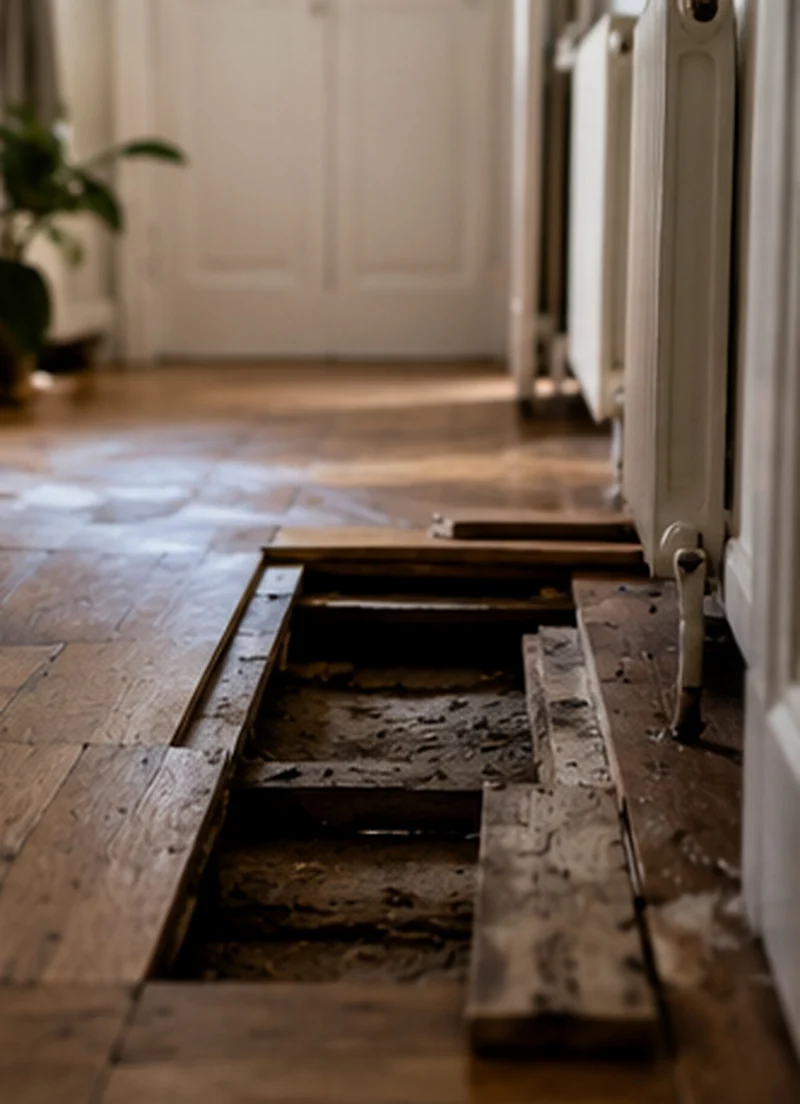
Around 100,000 homes (in Dutch) are sold in Flanders each year. For most buyers, that means a new home or a sound investment. For some, an unpleasant surprise follows. Within weeks, damp starts coming through the walls. The heating cannot keep the house warm. Or, worse still, the foundations turn out to be unsound. Here we explain what you can do as a buyer or seller, and what changes in 2027.
Suppose you buy a home. A few weeks later, you discover that some roof tiles are cracked. Can you hold the seller liable? Under the law and case law, you can only do so if four conditions are met:
- There is a defect;
- The defect is hidden;
- The defect is sufficiently serious;
- The defect already existed, at least in embryonic form, when the sale was concluded.
Condition 1: there is a defect
For a long time, courts interpreted the term ‘defect’ narrowly. Only a fault in the property itself counted: an ‘intrinsic’ or ‘structural’ defect, such as a sagging support beam, dry rot or asbestos.
To give buyers better protection, courts now also recognise ‘functional’ defects. A home may therefore be defective if it is unsuitable for the purpose for which it was bought, even if there is nothing physically wrong with it. For example, a lack of planning permission may in some cases amount to a defect. The buyer does not need to tell the seller that the property will be used as a home. But if the buyer has a particular use in mind, such as running a professional practice from home, they must make this clear to the seller before the sale. Only then can the seller provide the necessary information.
Condition 2: the defect is hidden
When is a defect hidden? There is no fixed formula. Lawyers call it a ‘question of fact’: the court considers the type of defect, how many times the buyers visited the property and the seller’s status, for example as a professional property developer.
The test is what an ordinary, careful inspection during a viewing would reveal. Anything the buyer could see or smell during that inspection is not hidden. Woodwork with visible woodworm damage, or a smell noticeable during a viewing, therefore does not, in principle, amount to a hidden defect.
The same applies to a defect the seller disclosed in advance. Conversely, a defect remains hidden if the seller presented a damp problem as ‘resolved’ when it was not. Suppose buyers only discover dry rot when they break open the floors. The defect will generally be hidden, because an ordinary buyer is not expected to break open floors before buying.
The type of home and the buyer’s status also matter. A private buyer is expected to know less than a professional buyer, such as a property developer. Nor does a private buyer have to arrange an expert inspection before buying, unless there are specific signs that something is wrong.
Condition 3: the defect is sufficiently serious
The defect must make the home unfit for its intended use, or impair that use so much that the buyer would not have bought it, or would only have paid a lower price, had they known about the defect. A home with a failed heating system is difficult to live in. The seller does not, however, have to provide a perfect home. A minor imperfection is not enough, and someone buying an older property can expect less than someone buying a new build. Exactly where the line lies remains a question of fact for the court to assess in each case.
Condition 4: the defect already existed when the sale was concluded
The defect must already have existed when the sale was concluded, at least in embryonic form. The seller is not responsible for defects that arise later or that the buyer causes. The burden of proof rests with the buyer. There is no statutory presumption in the buyer’s favour when a home is sold. The court can, however, infer from the circumstances that the defect already existed, for example where the defect comes to light shortly after the sale during normal use.
Price reduction or rescission of the sale
If all four conditions are met, the buyer has two options. They can have the sale rescinded: the buyer gets the purchase price back and the property goes back to the seller. Or the buyer can keep the property and ask for a price reduction. The parties can agree on the amount. If they cannot, an expert determines it. If the seller knew about the defect, they must also compensate the buyer for all loss suffered. If they did not, their liability is limited to repayment of all or part of the price and the costs of the sale.
What about an exclusion clause?
Many sale deeds state that the seller is not liable for hidden defects. Such a clause is valid, but it only protects a seller who did not know about the defect. A seller who did know cannot rely on the clause and must also pay damages. On 6 March 2025, the Court of Cassation confirmed (in French; no English translation available) that it is enough for the seller to have known about the defect and failed to disclose it. Bad faith or intent is not required. The buyer must still prove that the seller knew. The position is different for a specialised property seller (in Dutch; no English translation available): they are presumed to know about the defect and, in principle, cannot rely on such a clause, unless they prove that it was impossible to detect the defect.
What changes in 2027?
On 23 September 2026, the new Book 7, ‘Special Contracts’ (official text in Dutch and French; no English version available), of the Belgian Civil Code was published in the Belgian Official Gazette. For sales concluded on or after 1 September 2027, the law will no longer refer to hidden defects, but to a guarantee of conformity: the home must comply with the contract and with what the buyer can reasonably expect.
The vague requirement to act within a ‘short time’ will also disappear. The buyer must notify the seller of the defect within a reasonable period after discovering it or after they ought to have discovered it. The buyer then has two years to bring court proceedings. That period is suspended during serious negotiations between the parties. It is also suspended during a court-ordered expert assessment or an out-of-court expert assessment in which both parties take part. In any event, the buyer loses their right ten years and three months after delivery.
A seller who knew about the defect and concealed it cannot rely on late notification. Defects that only come to light more than ten years after delivery fall outside the guarantee. And where a business sells to a consumer, it cannot exclude that guarantee by contract. The current rules will continue to apply to homes sold before 1 September 2027, unless the parties agree otherwise. The decisive date is when the sale was concluded, usually the date of the private sale agreement (compromis), rather than the notarial deed.
Tip 1: prevention is better than cure
Visit the property more than once, preferably after rain as well, and take someone knowledgeable with you if you have doubts. Read the certificates the seller must provide carefully, such as the asbestos certificate (in Dutch) and the soil certificate. It will be difficult to argue later that something mentioned in those documents was a hidden defect.
Tip 2: do not wait too long
As a buyer, it is better not to wait. The law requires the claim to be brought ‘within a short time’ (our translation). This must be a court action, for example one initiated by a summons. A letter to the seller is not enough on its own. A buyer who notifies the seller immediately but waits five years before issuing a summons risks being too late.
How short is short? First, time only starts running when the buyer discovered the defect or could reasonably have discovered it. Second, the court considers all the circumstances, including the nature of the property and the defect. Dry rot is difficult to recognise in its early stages, which generally gives the buyer more time.
Third, the steps the parties take also count. If the buyers promptly have an expert appointed by the court, that weighs in their favour. Once the expert assessment is complete, they must act promptly again.
On 30 March 2026, the Court of Cassation reiterated (in Dutch; no English translation available) how negotiations affect that period. Serious negotiations towards an amicable settlement can suspend the short period. Once it is clear that a settlement is out of the question, time starts running again. In that case, an email from the buyer did not suspend the period, because the seller denied all liability, so there were no serious negotiations. In the meantime, the buyer had spent months having repairs carried out by third parties without informing the seller. The claim was brought too late. The case concerned a car wash, but the rule also applies to the sale of a home.
Tip 3: seek advice in good time
A defect in the home you have just put your savings into weighs heavily on your peace of mind and that of your family. What should you do?
Contact us first, before having the defect repaired. The March 2026 judgment shows why: repairs carried out without the seller’s knowledge counted against the buyer. We arrange for an assessment of exactly what the defect is, how it can be repaired and what that will cost. We then give the seller formal notice and seek a settlement. If a settlement is not possible, we prepare and handle the court proceedings.
DECKER LAW has extensive experience in property law and works with partners to deal with hidden defects. Court proceedings do bring us work, but we would rather give advice. That is why we first try to reach a settlement. Have you recently bought a home and are you now facing hidden defects? Or has a buyer brought a claim against you? Please do not hesitate to contact us.
← Back to Insights